Showing posts with label Biology. Show all posts

Friday, August 8, 2014

Can One Earthworm Become Two?

I'm sure everyone, at some point in their life, has heard that if you cut an earthworm in half, both halves have to potential to survive as independent entities. Sounds pretty cool! But is it true?


Earthworms are pretty remarkable creatures. They have an amazing ability to regenerate much of their bodies. Let's say you were to cut an earthworm in half. The front portion of the worm should include the mouth and a part called the "clitellum," which is the slightly broader un-segmented part, seen clearly in the photo below. Additionally, your cut should include at least ten segments more after the clitellum.


In this case, if you have made your cut in the proper location, the front half of the worm will indeed regenerate and become a whole worm once again. However, the back end of the worm is not viable, and will die. The mouth and the clitellum, which is where the worm's reproductive organs are, are vital to the worm's functions. Without them, there is no chance for survival.

However, while they are not "earthworms," there are some species of flatworm, known as "planarians," that are indeed capable of becoming two separate individuals after being bisected. In this case, the flatworm is split down the middle. Two two halves in some species of flatworm are able to regenerate and become two separate, living flatworms.

Polycelis felina, a freshwater planarian


Sources:

Moment, Gairdner B. (1942). "Simultaneous anterior and posterior regeneration and other growth phenomena in Maldanid polychaetes". Journal of Experimental Zoology 117: 1. doi:10.1002/jez.1401170102

"Gardening with children – Worms". BBC. Archived from the original on 2014-04-28.

Reddien, Peter W.; Alvarado, Alejandro Sanchez (2004). "Fundamentals of planarian regeneration". Annual Review of Cell and Developmental Biology 20: 725–57.


Photos:

"Earthworm". Licensed under GNU Free Documentation License 1.2 via Wikimedia Commons - http://commons.wikimedia.org/wiki/File:Earthworm.jpg

"Regenwurm1" by Michael Linnenbach - first upload in de wikipedia on 09:58, 16. Feb 2005 by Michael Linnenbach. Licensed under Creative Commons Attribution-Share Alike 3.0 via Wikimedia Commons - http://commons.wikimedia.org/wiki/File:Regenwurm1.jpg

"Polycelis felina" by Eduard SolĂ  - Own work. Licensed under Creative Commons Attribution-Share Alike 3.0 via Wikimedia Commons - http://commons.wikimedia.org/wiki/File:Polycelis_felina.jpg

Monday, August 4, 2014

Humans Only Use 10% of Their Brain. Poppycock!

On July 25th, a fascinating-looking film was released: Lucy, from director Luc Besson.


See the tagline, right near the top? "The average person uses 10% of their brain capacity. Imagine what she could do with 100%."

I'm here to tell you that that statement is complete bunk!

"But," you tell me, "it's a fictional movie! You can't expect every detail to be factually accurate!"

To you, I say, "quiet, stop getting in the way of me making a point."

But perhaps more importantly, this is a common misconception that has been very pervasive and persuasive. So while I don't expect fictional movies to get everything right, I do get annoyed when they perpetuate a myth that we seem to be unable to eradicate!

Human beings do, in fact, use 100% of their brains. In a typical day, a human being will at various times access virtually every part of their brain. Think about it this way: the brain is only about 3% of a human being's total body weight, but it uses about 20% of the body's energy. The brain is very demanding, needing a great deal of energy and resources to operate. If 90% of it were simply unused, excess grey matter, that would be a ridiculous tax on the body's resources for little to no benefit. Evolutionarily speaking, it would make no sense whatsoever.

Here are but a few more reasons why the "10% myth" makes no sense:

  • Brain damage: if 90% of the brain is unused, damage to those areas should have no effect. However, damage to nearly every part of the brain will have a detrimental effect.
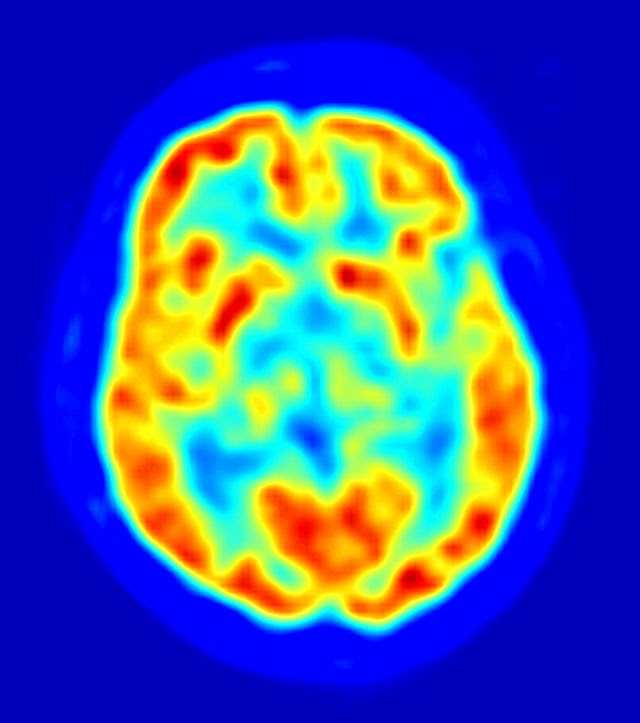
  • Brain scans show activity in all parts of the brain. There is no part of the brain that is never active.
  • If the typical human didn't use 90% of their brain, we would see that, through natural selection, people with smaller brains would have had a much higher survival advantage. As previously mentioned, the brain is a very demanding organ. Natural selection would have eliminated the huge, inefficient brains long ago.

PET scan of a human brain. We need all of it, not just 10%!


So, where did this myth come from? Most likely, it seems that misrepresentation or misinterpretation of the results of experiments done in the late 19th and early 20th centuries are the culprit. In any case, use of a miracle drug or exercises to "unlock" the remaining 90% of your brain power will not work.

This is not to say that Lucy is a bad film! Again, it's fiction: treat it as such. I haven't yet seen the movie myself, but I'm looking forward to it. Morgan Freeman and Scarlett Johansson? What's not to like?


Sources:

"Do People Only Use 10 Percent Of Their Brains?". Scientific American. 7 February 2008.

Beyerstein, Barry L. (1999). "Whence Cometh the Myth that We Only Use 10% of our Brains?". In Sergio Della Sala. Mind Myths: Exploring Popular Assumptions About the Mind and Brain. Wiley. pp. 3–24.


Photos:

"Lucy (2014 film) poster" by http://www.impawards.com/intl/france/2014/lucy.html.

"PET-image" by Jens Maus (http://jens-maus.de/) - Own work. Licensed under Public domain via Wikimedia Commons - http://commons.wikimedia.org/wiki/File:PET-image.jpg